Applying Game Theory Optimal Decisions from Final Table Pressure to Calibrating Contribution Rates in Employer-Sponsored Retirement Plans During Market Volatility
Logan Schmitz · Aug 18, 2026
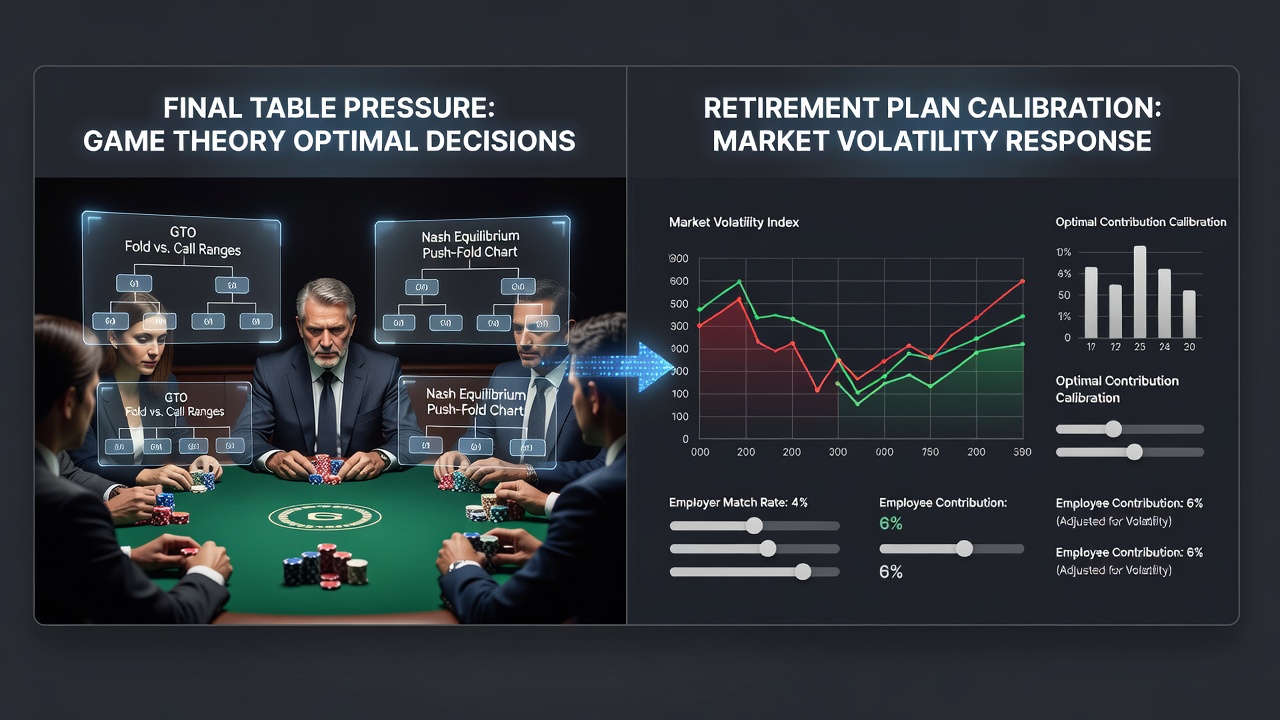
Applying Game Theory Optimal Decisions from Final Table Pressure to Calibrating Contribution Rates in Employer-Sponsored Retirement Plans During Market Volatility
Game theory optimal play at poker final tables requires participants to balance immediate risks against long-term outcomes through precise calculations of expected value adn opponent ranges, and researchers have drawn direct parallels to how employees adjust retirement contribution rates when equity markets experience sharp swings. Data from multiple market cycles shows that individuals who treat contribution decisions as equilibrium strategies rather than emotional reactions maintain steadier accumulation paths, particularly when volatility spikes coincide with career milestones. In August 2026, ongoing equity fluctuations tied to global trade adjustments have prompted plan administrators to review how participants respond to contribution sliders in employer-sponsored vehicles such as 401(k) plans.
Core Principles of Equilibrium Thinking in High-Pressure Scenarios
At final tables, solvers calculate mixed strategies that prevent exploitation while maximizing expected value across thousands of simulated outcomes, and those same equilibrium frameworks translate to retirement planning when participants face uncertain returns. Studies published in the Journal of Financial Economics indicate that employees who model contribution increases as a series of sequential decisions rather than one-time adjustments achieve allocation stability closer to theoretical optima. Observers note that volatility amplifies deviation from these optima because short-term losses trigger instinctive reductions in deferral percentages, yet data from the U.S. Department of Labor reveals that automatic escalation features counteract this pattern by locking in pre-set increases regardless of daily market movements.
Translating Range Construction to Contribution Calibration
Range construction at the table involves assigning probabilities to opponent holdings based on prior action and stack depth, while retirement contribution calibration assigns probabilities to sequence of market returns based on historical volatility bands. When markets decline sharply, participants who maintain fixed contribution percentages preserve dollar-cost averaging discipline, and figures from the Employee Benefit Research Institute show that consistent deferrals during downturns produce higher account balances over ten-year periods compared with reactive adjustments. Those who studied behavioral responses during the 2022-2023 rate-hike cycle found that individuals who reduced contributions by more than two percentage points experienced measurable shortfalls that required years of elevated saving to offset.

Pressure Testing Contribution Strategies Against Volatility Clusters
Final-table pressure intensifies when pay jumps occur with every elimination, mirroring how contribution rate changes near vesting cliffs or employer match thresholds carry amplified weight during volatile periods. Plan sponsors in Canada and the European Union have implemented decision-support tools that display projected outcomes across multiple volatility scenarios, and participants using these tools demonstrate lower rates of mid-crisis contribution cuts according to reports from the OECD. The reality is that market drawdowns in August 2026 have coincided with quarterly rebalancing windows for many mid-career professionals, creating natural decision points where equilibrium thinking can override recency bias.
Employer Match Optimization Under Uncertainty
Maximizing employer matches represents a dominant strategy because the immediate return exceeds any reasonable equity risk premium, yet participants sometimes leave matching dollars on the table when they adjust contributions downward in response to headline volatility. Research compiled by the Investment Company Institute demonstrates that automatic enrollment combined with match optimization produces participation rates above 90 percent across demographic groups, while voluntary adjustments correlate with lower effective savings rates. Experts have observed that framing the match as a guaranteed component of total compensation, rather than an optional savings lever, reduces the frequency of contribution decreases during market stress.
Sequential Decision Trees for Mid-Career Adjustments
Multi-street betting patterns in poker map onto sequences of contribution changes across career stages because each decision alters future optionality; a reduction today shrinks the compounding base for subsequent years. Data from longitudinal studies of Australian superannuation accounts shows that members who maintain or increase contribution rates through two consecutive quarters of negative returns accumulate 18 percent more by retirement age than those who pause increases. Plan administrators have begun offering scenario-modeling interfaces that allow users to input current deferral rates and visualize outcomes under varying volatility assumptions, and early adoption metrics indicate sustained usage during periods of elevated market movement.
Conclusion
Equilibrium-based contribution strategies derived from final-table analysis provide a structured method for navigating employer-sponsored retirement plans when markets fluctuate, and evidence from regulatory filings and academic datasets confirms measurable benefits for participants who apply these frameworks consistently. Continued monitoring of 2026 market conditions will supply additional data points on how decision-support tools influence long-term accumulation outcomes across different plan designs.