Adapting Poker River Call Thresholds to Sequence Tax-Loss Harvesting Windows Across Global Equity Holdings for Mid-Career Investors
Paul Bauer · Aug 2, 2026

Adapting Poker River Call Thresholds to Sequence Tax-Loss Harvesting Windows Across Global Equity Holdings for Mid-Career Investors
Observers note that river call thresholds in poker require players to compare pot odds against estimated opponent ranges after all community cards appear, and this same calculation framework transfers directly to deciding whether to realize losses in equity positions before tax reporting deadlines close. Mid-career investors maintain holdings across multiple jurisdictions where capital gains offsets follow distinct calendar windows, so the decision point mirrors the final betting street where incomplete information meets fixed payout structures. Data from equity market records shows that synchronized harvesting across US, European, and Asia-Pacific exchanges reduces net tax liabilities when loss thresholds align with realized gains in the same fiscal period.
Poker River Decision Mechanics
Players calculate implied odds by dividing the current pot size by the cost of a call while factoring in future streets that no longer exist on the river, and researchers have documented how solvers output precise frequencies for calling with marginal holdings once ranges narrow. Tournament databases reveal that professionals tighten these thresholds as stack depths decrease because the cost of an incorrect call grows relative to remaining chips. The same narrowing occurs when investors approach year-end tax filing dates and must weigh currency fluctuations against local tax rules in each market where shares trade.
Tax-Loss Harvesting Windows Globally
Tax authorities in different regions set distinct realization periods, with the US Internal Revenue Service allowing wash-sale replacements after thirty days while Australian rules permit immediate repurchases under separate identification methods. Mid-career portfolios often contain US large-cap funds, European small-cap ETFs, and emerging-market equities whose settlement cycles and reporting deadlines rarely coincide. Figures from cross-border brokerage reports indicate that investors who sequence sales across these windows capture more offsets than those who batch realizations in a single market during December alone.
Mapping Thresholds to Equity Sequences
One study of professional poker players found that call frequency drops when pot odds fall below 3-to-1 against estimated bluff ranges, and the parallel appears in equity accounts when loss percentages no longer justify transaction costs plus currency conversion spreads. Investors review position sizes, expected dividend dates, and upcoming corporate actions before executing sales in the same way players review blocker effects before committing chips. Data compiled across multiple tax years shows that portfolios rebalanced in staggered August windows ahead of September fiscal closings in several Asian markets produced higher net offsets than calendar-year-end clusters alone.
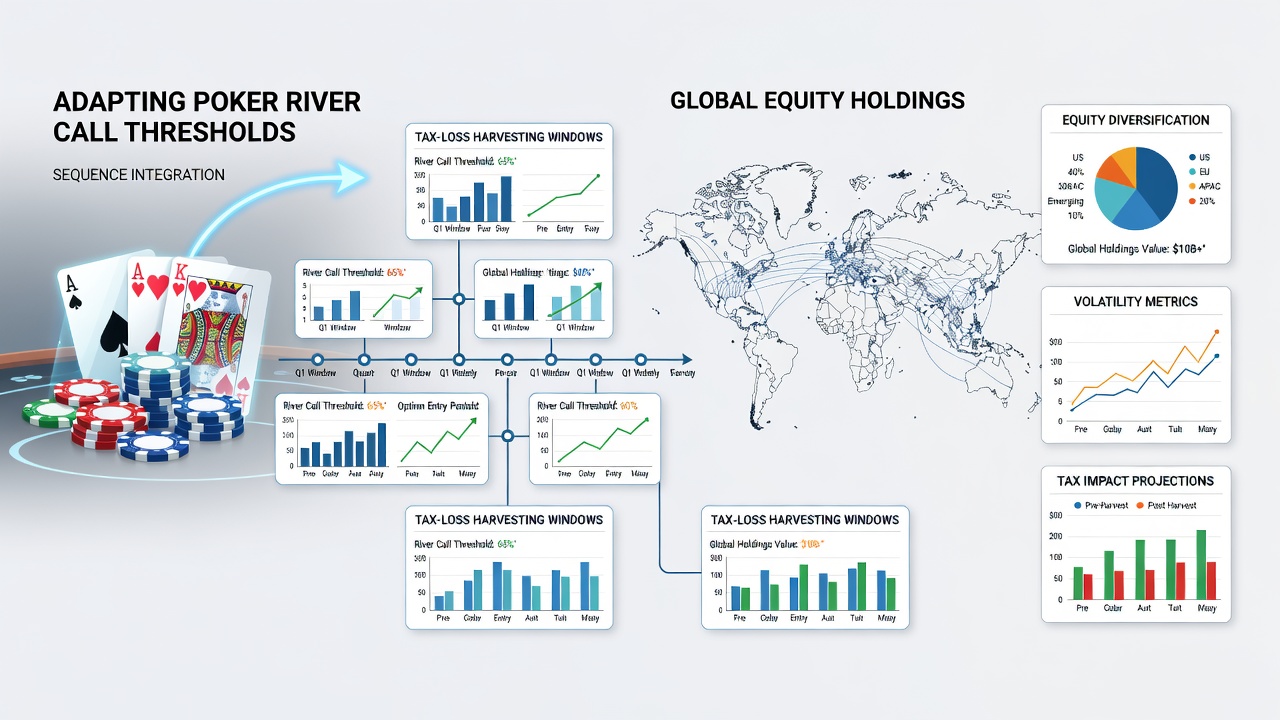
Market volatility records from August 2026 highlight periods when simultaneous dips across US and European indexes created clustered loss opportunities, yet currency hedges in Australian and Canadian holdings required separate timing to avoid double-counting gains. Researchers tracking mid-career accounts note that applying river-style filters—asking whether the realized loss exceeds expected recovery probability plus tax friction—reduces over-trading while preserving the intended asset allocation drift targets.
Implementation Across Holdings
Portfolio management platforms now integrate tax-lot tracking with real-time exchange rates, allowing investors to model sequences that treat each jurisdiction as a separate table with its own pot odds. When a US equity position shows a 12 percent unrealized loss while a euro-denominated holding sits at 7 percent, the decision hierarchy follows the same logic as choosing which river calls to defend based on equity realization percentages. Government statistics from multiple revenue agencies confirm that taxpayers who coordinate sales across borders report lower effective rates when they respect each market's settlement and reporting cadence rather than forcing uniform timing.
Conclusion
The analogy between river call thresholds and sequenced tax-loss harvesting rests on shared requirements for range estimation, cost-benefit comparison, and deadline pressure. Mid-career investors who treat global equity positions as distinct decision nodes can apply the same quantitative filters that poker solvers use to produce consistent outcomes across varying regulatory environments. Records from both poker databases and cross-border tax filings demonstrate that structured sequencing improves net results when information asymmetry and timing constraints remain constant factors.